
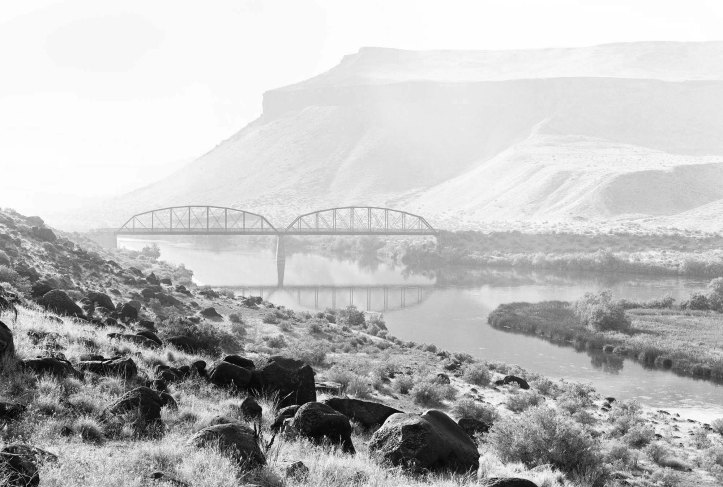
I’ve spent many happy days on the Snake River: fishing, photographing, and exploring. I like the Snake River. I like its aroma, its beauty, and its ancient, ceaseless flow.
One of my favorite places on the Snake is Guffey Bridge. Located at Celebration Park just south of Melba, it was built in 1897 for the railroad to transport ore from the mines of Silver City. Today, it serves as a walking path. The ground surrounding Guffey Bridge is covered in piles of loose boulders. For years, I wondered how they got there.
Fourteen thousand years ago, Lake Bonneville covered most of northern Utah and parts of southern Idaho and Nevada. It was a lake without an outlet, growing continuously from the rivers and creeks of the Wasatch Front. This massive body of water, as deep as 1,000 feet, grew for thousands of years until it finally began spilling over Red Rock Pass in southeastern Idaho. The spill evolved from a trickle to a cataclysmic flood when the pass crumbled and all that stored water finally found its escape route. Over the next eight weeks, the level of Lake Bonneville dropped by 350 feet.
As the torrent poured over Red Rock Pass, it surged into the Snake River Canyon. It scoured the landscape, tearing boulders loose from the volcanic rock walls. These stones swirled and tumbled in the flood before being deposited as the water finally slowed. Can you imagine the hydraulic force required to move these massive stones? It’s said that the low hum of the floodwaters could be felt for hundreds of miles.
Sometimes, when I visit Celebration Park, I touch these boulders, hoping to receive their traumatic stories through my fingertips. They, of course, never speak to me, but I still like to imagine the terrible flood that ripped them from their canyon homes as I walk among them.
 jonballblog.com